
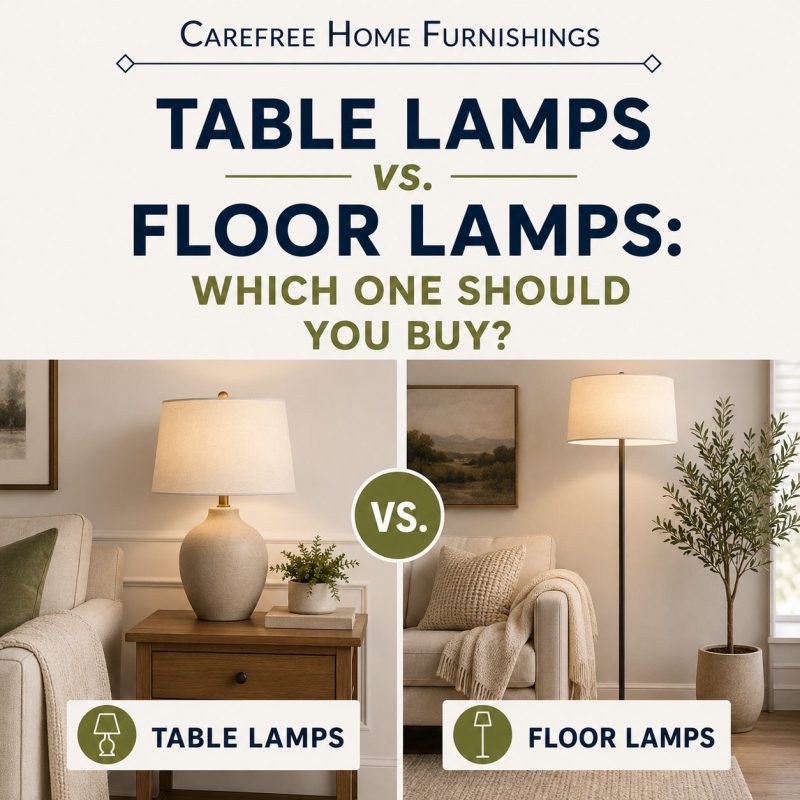
Table Lamps vs. Floor Lamps: Which One Should You Buy?
Jun
Picking a lamp shouldn’t take long. It’s a lamp.
But most people have been in this situation: you buy one, get it home, plug it in, and the room looks almost exactly the same as before. Maybe slightly worse, because now there’s a lamp in it that isn’t doing much.
Here’s the thing — nobody goes looking for a lamp because they’ve developed a sudden interest in lighting. It usually starts with one ceiling fixture that’s supposed to cover an entire room and doesn’t. The living room goes flat after dark. The corner by the sofa turns into a black hole at night. The corner next to the sofa disappears at night. You can’t read without flooding the entire room with light. The same goes for the home office — it looks fine during the day, but feels harsh and uninspiring once evening rolls around.
At that point, the question isn’t really whether a desk table lamp looks better than a floor lamp. It’s which one fixes the problem you’re actually dealing with.
The one-light-for-everything problem
Most rooms look fine in the middle of the day. The real test comes later, usually around eight or nine at night.
Can someone curl up with a book without turning the whole room into a spotlight? Can someone else watch TV comfortably? Does the room still feel inviting… or does everyone end up moving to the kitchen because it’s the only place that feels right?
Designers have a term for fixing this. It’s called layered lighting (sounds more complicated than it is). The idea is simply not to let one ceiling fixture do all the work. Instead light is spread throughout the room by putting a lamp beside a reading chair, one on a console behind the sofa, and something tucked into the forgotten corner of the room.
That’s why table lamps and floor lamps aren’t really competing choices. Most of the time, they’re solving entirely different problems. One puts light where people already spend their time. The other helps bring life back to parts of the room that never quite worked after dark.
Table lamps are usually for spaces you’ve already settled into
A table lamp usually ends up in places where people already spend time.
The nightstand where you read before bed. The desk where bills pile up. The side table next to the chair everyone gravitates toward when guests come over.
That’s why desk table lamps make so much sense in home offices. If you’re answering emails at 9 p.m., helping your kid finish homework, or just reading with your morning coffee, you don’t need light floating around somewhere nearby. You need it exactly where your eyes are focused.
People also underestimate how much size matters. A lamp that’s too tall can overpower a small side table. One that’s too short defeats the purpose. And if the base is too bulky, your bedside table will have no room left for a book, a glass of water, or a phone charger.
A good table lamp doesn’t necessarily become the star of the room. What usually changes are the little things. Reading gets easier. Working feels less tiring. You stop turning on the ceiling light every time you sit down because you no longer need it.
Floor lamps solve problems that furniture can’t
People end up buying floor lamps because they’ve realised a room still looks unfinished despite having all the furniture they thought they needed.
Maybe the sofa sits in the middle of an open-concept space with nowhere convenient to put a side table. Maybe every available surface is already taken up by books, plants, framed photos, coffee mugs. Or maybe there’s just a corner that’s been ignored for years because nothing ever looked right there.
A well-placed floor lamp can sort all three of those situations.
An arc lamp extending over a reading chair delivers focused light without touching the side table at all. A tall shaded lamp can pull a dark corner back into the room and make the whole space feel more balanced. Even a slim torchiere lamp tucked into an empty spot can change the mood of a room.
This is a big reason why modern floor lamps for living room spaces continue to be such a popular choice. They work well in homes where people want things to feel comfortable at night without depending entirely on recessed lighting or ceiling fixtures that were never particularly flattering to begin with.
If you’re shopping for the best floor lamps for living room use, one question cuts through most of the noise: what is this lamp actually supposed to do? A reading lamp, a conversation area light, and something decorative for an empty corner are three pretty different products, even if they all technically qualify as floor lamps.
On statement lighting
People hear the phrase “statement lighting” and picture oversized chandeliers or sculptural fixtures that look like they belong in a hotel rather than a real home.
It rarely works out that way in practice.
A ceramic table lamp with a textured shade on an entry console can have just as much impact as something much larger or more expensive. The same goes for a tall floor lamp beside a sofa. What makes these pieces stand out isn’t necessarily their size. They simply feel intentional and help the room look more put together.
The even bigger mistake is trying to make everything in the room a focal point. A bold coffee table, colorful artwork, patterned accent chairs, decorative shelves, and an eye-catching lamp can all look great on their own, but together they can look too overwhelming.
In many cases, one interesting lamp does more for a room than several pieces all trying to stand out at the same time.
So which one should you buy?
If you need focused light where you already spend time, a table lamp is probably the better investment.
If you’re trying to brighten an awkward corner, add some height to a room, or avoid cluttering another surface, a floor lamp often makes more sense.
And if the room seems to need both, that’s not unusual. Most well-used spaces do, because the lighting that works at 10 a.m. may not feel right at 10 p.m.
The easiest place to start is with one question — are you trying to improve a routine you already have, or fix a part of the room that never quite worked in the first place? One of those is a table lamp problem. The other usually isn’t.
A table lamp lights up spaces you already use — a nightstand, desk, or side table — while a floor lamp brightens areas that don’t have a surface nearby, like an empty corner or the space beside a reading chair.
Yes, but they solve different problems. A floor lamp works well when there’s no table or surface available, while a table lamp is better when you need focused light exactly where you sit or work.
Many rooms do benefit from both. A table lamp handles up-close tasks like reading or working, while a floor lamp fills in gaps and balances the overall light in the room.
Yes — a slim or torchiere-style floor lamp can brighten a room without taking up surface space, which makes it a practical choice for smaller living rooms
This usually happens when the lamp isn’t positioned to fill the actual problem area, like a dim corner. Moving the lamp closer to the area that lacks light, rather than just placing it near furniture, usually solves this.
A good rule of thumb is to pick a lamp where the base and shade together are about one-third the width of the nightstand, so it doesn’t overwhelm the space or block room for other items.